SILVER LEAF OFFICE

Blog

Bookkeeping tips to help you build a solid financial foundation for your business.
  • Home
  • About
  • Blog
  • Resources
  • Contact

4/18/2018

Budgeting for your Creative Business

0 Comments

Read Now
 
Picture
Did you know that your business needs a budget? Yes, just like you need a budget for your personal finances you need one for your business. Managing money is essential if you want to succeed in your business. Part of being successful at this is having a monthly budget.

Yes, I know you're a creative and this is overwhelming. But stay with me. I'll make this quick and painless. 
 
​The goal of a budget is to make the most of the resources you have in order to reach your business goals (and probably some personal ones too!). A budget is simply telling your money where to go instead of wondering where it went. 

Here are three steps to start your business budget:
  1. Determine your revenue (income before expenses). It is important to do this first because you cannot spend money without first knowing how much money you have to spend. It might help you to be specific in this area so you can see the services (or products) that bring in the income. For example, if you are a website designer you can list specific revenue sources, such as website templates and custom work. For photographers, you may you can use categories like wedding photography, portrait photography, and print sales.
  2. Write down your fixed expenses. Certain expenses are always the same no matter how many clients you serve. Write these predictable expenses first as they are the easiest to figure out. Examples: Internet, website hosting, cell phone, business insurance, bookkeeping, accounting.
  3. Calculate your variable expenses. These will be harder to figure out because they fluctuate month-to-month and depend on the number of clients you serve. The key here is to make an educated guess and adjust later as necessary. Examples: stock photography, office supplies, advertising, continuing eduction, travel.

Now set up your budget like this:
Revenue
Wedding Photography        $ 5,000
Print Sales                                 500
Total Revenue                     $ 5,500 

Expenses   
Office Supplies                     $    100
Utilities/Telephone                    200
Training/Education                     50
Advertising                                100
Travel                                        250
Insurance                                     50
Total Expenses                     $    750
Total Revenue                       $5,500
Less Total Expenses                  (750)
= Gross Profit                         $4,750

Less Taxes (15% x $4,750)†      (713)
= Net Profit                            $4,037

†Note: The 15% for taxes is an estimate. Consult
with a CPA to customize it to your business.
Remember when you first start your business you will not be able to create a perfect budget. Budgets develop over time. Make an educated guess at the beginning and adjust it every month until you have something that works for you. 

Share

0 Comments

1/8/2018

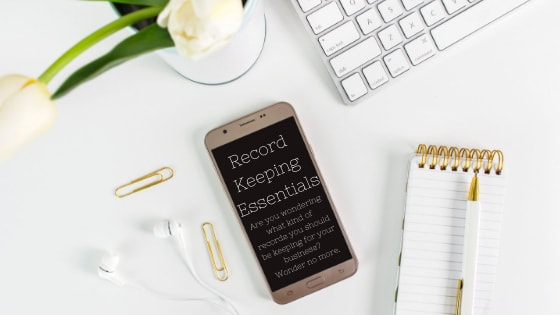
Record Keeping Essentials for Creatives

0 Comments

Read Now
 
Picture
Keeping records is an important part of running your own business (and probably one of the most dreaded things for creatives!). Good records:
  • Keep you sane. No more worrying about where to find your important documents.
  • Save you time. 
  • Help you prepare for tax time.
Are you wondering what kind of records you should be keeping? Wonder no more. Here is a list of the files every small business should have:
Bank Records: Anything bank related: bank statements, bank reconciliations, notices from your bank, and deposit slips. 
Marketing & Advertising: Brochures, business cards, etc. 
Business Records: Corporations: articles of incorporations, bylaws, state filings. Non-corporations: LLC documents, state filings. Also, permits and/or licenses needed to operate your business in your city or state.
Employee records: Employment applications, W-2s, termination letters, time sheets, payroll information, agreement of wages. 
Tax records: Quarterly and annual tax filings, W-9s from independent contractors, documents supporting your tax records, 1099s filed. (hint: the more efficient your record keeping system the easier it is to prepare for tax season!).
Client Records: contact information, contracts. Many photographers and website designers use Dubsado or Honeybook to simply this process!
Accounting & Bookkeeping Records: Receipts, business credit card statements (plus receipts to back them up), invoices, income statements, balance sheets. If you want a simple system I recommend QuickBooks Online. It'll track everything you need for bookkeeping and make tax time a breeze! Plus it can easily sync with Honeybook or Dubsado.
You can keep these files in a filing cabinet, on your computer, or in a cloud-storage system (or any combo of these). Personally, I use all three options. I use QuickBooks Online for my client and bookkeeping records [cloud-storage system], file boxes for important business documents, and my computer for tax and and business records. 

Remember that it is never too late to start a good record keeping system. Even if you’ve been in business for a few years and have let your files fall behind there is no time like the present to get yourself organized. ​

And if you're wondering how long you should keep these documents in your files before you you shred them check out my free guide.

Share

0 Comments
Forward>>
Details

    Categories

    All
    1099s
    Accounting Software
    Benefits Of A Bookkeeper
    Budgeting
    Business Expenses
    Categorizing Expenses
    Emergency Savings
    Hiring A Bookkeeper
    Keeping Records
    QuickBooks Online
    Receipts
    Success Story
    Tax Deductions
    Tax Savings
    Tricks + Tips

Bookkeeping services for small businesses
Schedule a call
Privacy Policy. Disclaimer. 
"Commit your work to the Lord" Proverbs 16:3
©2026 Silver Leaf Office LLC
  • Home
  • About
  • Blog
  • Resources
  • Contact